Experience · Dec 2018 – Aug 2020
EPAM Systems (Belarus)
Lead Experience Designer
EPAM (NYSE: EPAM) is an engineering company that designs and builds digital products for large enterprises, including Forbes Global 2000 clients. In 2025 it reported $5.457 billion in revenue and about 62,850 employees, of whom about 56,600 were delivery professionals. The firm has delivered custom software for more than thirty years.
- Period
- Dec 2018 – Aug 2020
- Location
- Belarus
- Team
- 4 designers
- Selected portfolio
- 2 products
The role
Enterprise platforms, designed to operate at scale.
At EPAM, I led experience design for two enterprise platforms where the hard part was not a single screen; it was making a connected system work across roles, departments, and specialized domains. I led a team of four designers while staying hands-on with information architecture, interaction models, and the workflows that carried each product from entry to completion.
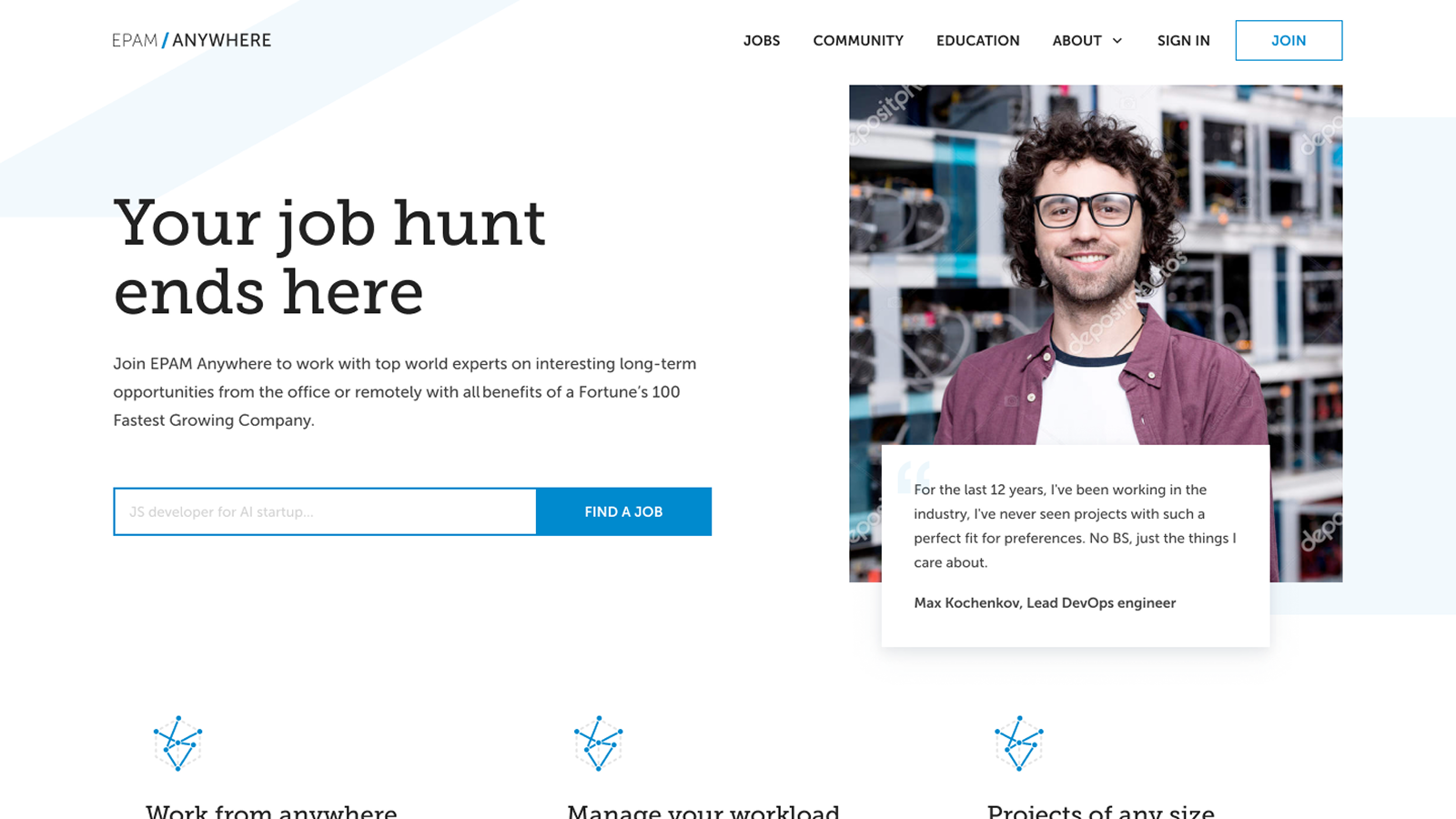
EPAM Anywhere
Employee services at global scale
EPAM Anywhere brought staffing, work support, benefits, and other employee services into a self-service platform for more than 60,000 specialists. The experience had to remain coherent even as a person’s options changed by role, department, geography, and operational context.
- Organized services around the specialist’s journey. I shaped the information architecture and interaction model so people could move between assignments, support, and benefits without having to understand the departments behind them.
- Set direction across connected teams. I partnered with distributed product, engineering, and service teams to align workflows that crossed ownership boundaries and keep the platform consistent as each area evolved.
- Designed for variation without fragmenting the experience. Shared patterns gave different services a recognizable structure while leaving room for the rules and constraints of each region and role.
The result was a more coherent way for specialists to navigate the services behind remote work, with design decisions that could extend across the wider platform rather than solve one departmental flow at a time.
Schlumberger
Clarity without flattening the domain
For Schlumberger, I designed workflows for an internal analyst platform used in reservoir engineering. Here, the challenge was different: the product had to make highly specialized analytical work usable without hiding the technical detail analysts relied on.
- Learned the work before simplifying the interface. I worked with reservoir-domain experts to understand the sequence, terminology, and dependencies behind analytical tasks before translating them into product flows.
- Separated domain complexity from interaction complexity. I preserved the information and controls required for accurate analysis while removing avoidable friction in how analysts moved through the work.
- Carried decisions into implementation. I partnered with engineering to make sure the designed workflows represented the underlying technical process accurately, not just the ideal path shown in a prototype.
Across both products, my role was to turn organizational or domain complexity into interfaces people could operate with confidence, and to give adjacent teams a shared direction for building the next part of the system.
Related portfolio