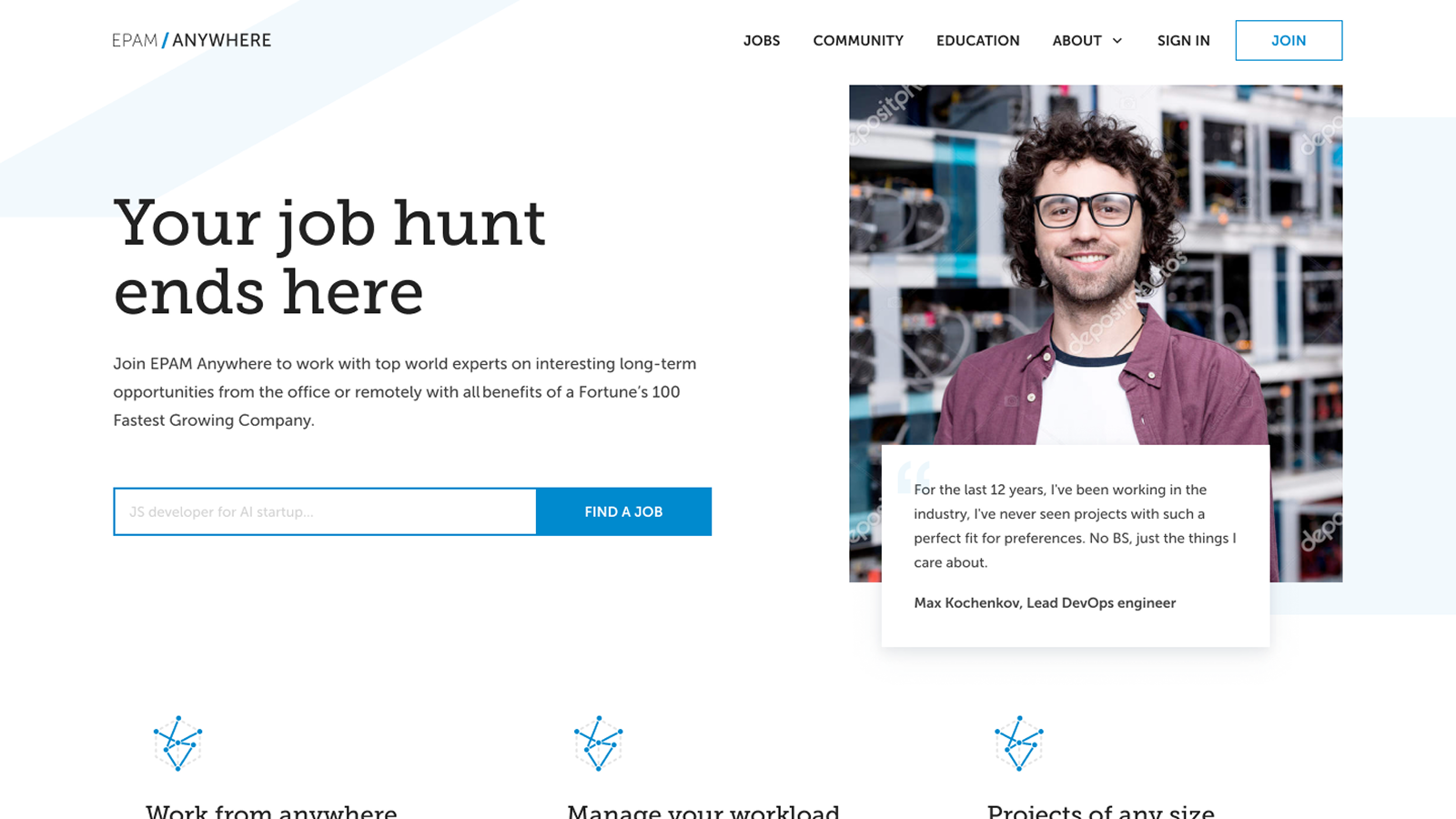
EPAM Anywhere
Self-service for 60,000+ specialists: staffing, support, and benefits.
EPAM Anywhere set out to give IT specialists the flexibility of remote assignments without asking them to give up the stability, support, and benefits of full-time employment. I led the design team while contributing directly across research, service modeling, product definition, and interface design.
Overview
The project was part product design and part organizational transformation: turn the capabilities of a large, decentralized, office-based company into a coherent remote experience for candidates, employees, delivery teams, and clients.
Goal
- Create a job platform for software engineers, business analysts, designers, and other IT specialists seeking full-time remote assignments.
- Combine freelance-like flexibility with work support, learning opportunities, corporate benefits, and the stability of employment.
Challenge
- Adapt processes built around offices and local teams to a combination of office and remote work.
- Create one understandable experience from practices distributed across a large global organization.
My role
- Led the design team and structured the work across discovery, ideation, service modeling, and delivery.
- Contributed hands-on at every stage, from interviews and competitive research to diagrams, value propositions, and the UI library.


Discovery
We researched both sides of the employment experience: what specialists expected from remote work and what EPAM needed to recruit, support, staff, and retain them.
Candidate expectations were broader than a job listing
A remote role had to communicate not only the assignment, but also the stability, support, development, and benefits that distinguished it from freelance work.
Interview people entering the system
We spoke with external candidates and recently hired onsite employees to understand their questions, motivations, and concerns at the point of joining.
The hiring process assumed an onsite model
Existing recruiting practices had evolved around office-based employment and could not simply be copied into a remote journey.
Learn from talent acquisition
Interviews with an EPAM talent acquisition representative helped us map the hiring process and identify what had to change for remote recruitment.
Remote companies already had clear narratives
EPAM was entering a category shaped by remote-first companies, staffing platforms, and freelance marketplaces with established value propositions.
Find a defensible position
We reviewed roughly 30 competitors, scored them, and studied the top 10 in depth to identify where EPAM could offer a meaningfully different combination of flexibility and employment.


A multi-sided service
The experience could not be designed around the candidate alone. We defined the people who would enter, operate, support, buy, and manage the service, then used those perspectives to expose dependencies between the public platform and internal processes.
Talent
- Candidate
- Remote employee
- Remote employee using a lighter benefits package
Delivery and hiring
- Talent acquisition specialist
- Team lead
- Project manager
Clients
- C-level owner of an external team
- Startup founder or manager
Competitive analysis
A scorecard made a broad market review comparable. The deeper analysis went beyond websites and feature lists to examine how each business attracted talent, sold delivery capacity, and supported work after a match.
Market and offer
- Client size and geography
- Project types and team sizes
- Product and service offerings
- Marketing value propositions
- Competitive strategy and revenue streams
Operating model
- Processes for new clients, projects, and employees
- Learning and development programs
- Employee benefits
- Hourly rates and payment systems
From organizational knowledge to a shared model
EPAM already had many of the capabilities the service needed, but they were distributed across teams and systems. Each designer investigated an internal process, then brought the findings into knowledge-sharing sessions where we discussed dependencies, gaps, and possible applications to the remote model.
Behavioral models
- Activity and use-case diagrams
- Interaction-overview and timing diagrams
- Communication and sequence diagrams
Structural models
- Candidate and remote-employee profiles
- Job-position model
- Customer profile
Product direction
The research pointed to two connected design problems: explain a distinct promise to every participant and make the experience feel like one EPAM product despite the systems behind it.
One generic message could not serve every audience
Candidates, remote employees, delivery leaders, hiring specialists, and clients entered the service with different goals and different reasons to trust it.
Design a value proposition for each persona
We translated the research into persona-specific propositions, connecting each audience to the assignments, support, people, or delivery outcomes most relevant to them.
Branding varied across internal applications
The platform had to connect multiple company processes, but inconsistent visual systems risked making the journey feel fragmented.
Create a shared UI component library
I helped establish a design library that reconciled EPAM’s public brand with the patterns used by its internal applications, giving the new service a consistent foundation.
Validation and measurement
We paired qualitative feedback with a quantitative framework so the team could improve both the visible experience and the business processes behind it. The available project record defines the methods, but does not include post-launch figures.
Qualitative
- Tested the primary user flows.
- Interviewed participants after testing to understand expectations, confusion, and confidence.
Quantitative
- Structured funnel measurement around acquisition, activation, retention, referral, and revenue.
- Planned traffic analysis and A/B testing.
- Used product signals to identify opportunities for business-process optimization.
What the work demonstrated
Designing the platform meant designing the service behind it. The strongest product direction came from connecting candidate research, recruiting knowledge, delivery operations, client needs, and interface standards in one model.
Research the system
- A remote-work proposition depends on hiring, staffing, support, learning, benefits, and client delivery, not only the application experience.
Make complexity discussable
- Behavioral and structural diagrams gave a distributed team concrete artifacts for aligning processes before committing to screens.
Build for coherence
- The component library and persona-specific propositions created consistency at both the interface and service levels.